Brightbill
The Wild RobotBrightbill is the gosling who becomes the adopted son of the robot Roz, and his life story is the emotional engine of the island narrative. He is introduced as a tiny, seemingly doomed hatchling, but he grows into a strong swimmer, a talkative young goose, and ultimately the graceful leader of a fast-flying flock that returns to the island in perfect formation. His existence transforms Roz from a solitary machine into a mother, and his departure and return give the story its most powerful arc of love, loss, and reunion.
Identity and Introduction
Brightbill's identity is forged in the moment of his naming, an event that nearly does not happen. When the goose Loudwing lands on Roz's head and peers into the nest, she declares the hatchling to be "certainly a very small thing" and calls him a runt, warning Roz that runts "do not usually last very long" and that with a robot for a mother, he would need a miracle to survive. Despite this grim prognosis, Loudwing insists that the gosling deserves a name, noting that his beak is of an unusually bright color, which she finds rather charming. She offers that if she were his mother, she would call him Brightbill, but she leaves the decision to Roz. Roz immediately accepts the name, declaring, "His name will be Brightbill," and announces her plan to find a sturdy tree near the pond so he can be around other geese. This naming scene establishes Brightbill's defining traits: his small size, his bright beak, and the precariousness of his existence, as well as the central conflict over where he should live, with Loudwing insisting that a gosling must live on the ground like a normal goose, not in a tree.
Life and Growth
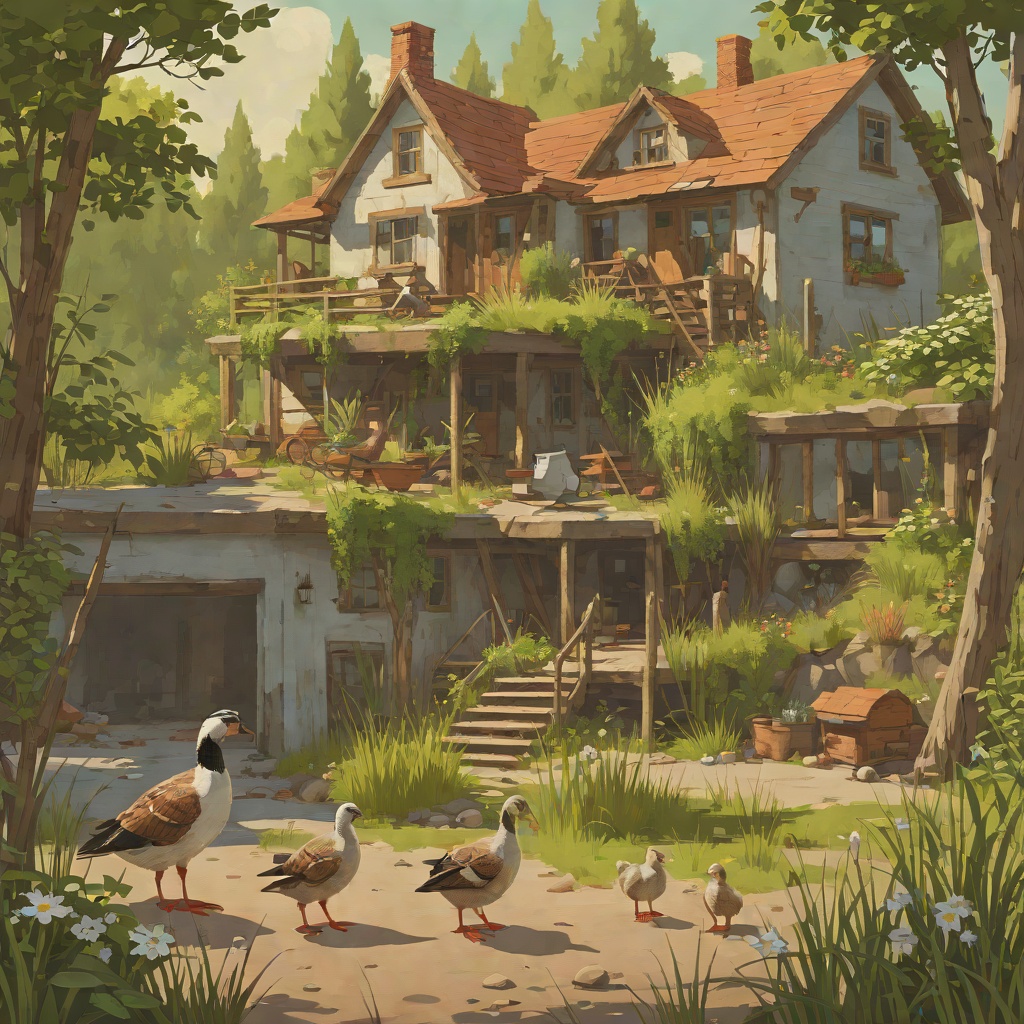
Brightbill's early life is marked by rapid development and a voracious appetite. He quickly forgets an early incident with Rockmouth and spends his mornings swimming around the pond with the other goslings, becoming an excellent little swimmer. He also becomes an excellent little talker, introducing himself to anyone who would listen with the cheerful greeting, "Hello, my name is Brightbill!" Despite being small for his age, a condition that would persist, he grows bigger and stronger day by day, his increasing size matched by his increasing appetite. He devours grass, berries, nuts, and leaves, and sometimes nibbles on small insects; if something was edible, Brightbill would eat it, and even if it was not edible, he might still eat it. This indiscriminate eating causes Roz a moment of fright when she sees him swallowing pebbles on the beach, and she holds him upside down hoping the stones will fall out of his mouth. Loudwing intervenes, laughing, and tells Roz to put the goose down, explaining that it is perfectly natural for Brightbill to eat a few pebbles, as they will help him digest his food, though she cautions him not to eat too many.
The Bond with Roz and the Wild
The relationship between Brightbill and Roz is the central emotional relationship of the book, and it is built on Roz's determination to be a proper mother despite her mechanical nature. Roz's protective programming drives her to care for the gosling, and her efforts to understand and integrate into the wild are largely motivated by her need to raise him. This is part of a broader pattern in which Roz learns the language of the animals, a process that began with the birds, who had always been nervous when the robot was near, staring and shrieking before scattering. Once camouflaged, Roz could secretly observe their normal behavior up close, noticing chickadees flitting among the same flowers and singing the same song each morning, a lark diving onto the same rock and singing the same song each afternoon, and two magpies singing together each evening across the same meadow. After weeks of robotic study, Roz knew what each bird would sing, when it would sing, and finally why it would sing, and she began to understand the birds, and then the porcupines, salamanders, and beetles, discovering that all the different animals shared a common language, each species speaking it with its own accent. This understanding of the wild is directly tied to Brightbill's upbringing, as Roz's ability to communicate and her willingness to learn survival techniques from the animals, as she requests when she tells them, "I have observed that different animals have different ways of surviving. I would like each of you to teach me your survival techniques," are all in service of creating a life for herself and her son.
Key Actions and the Return
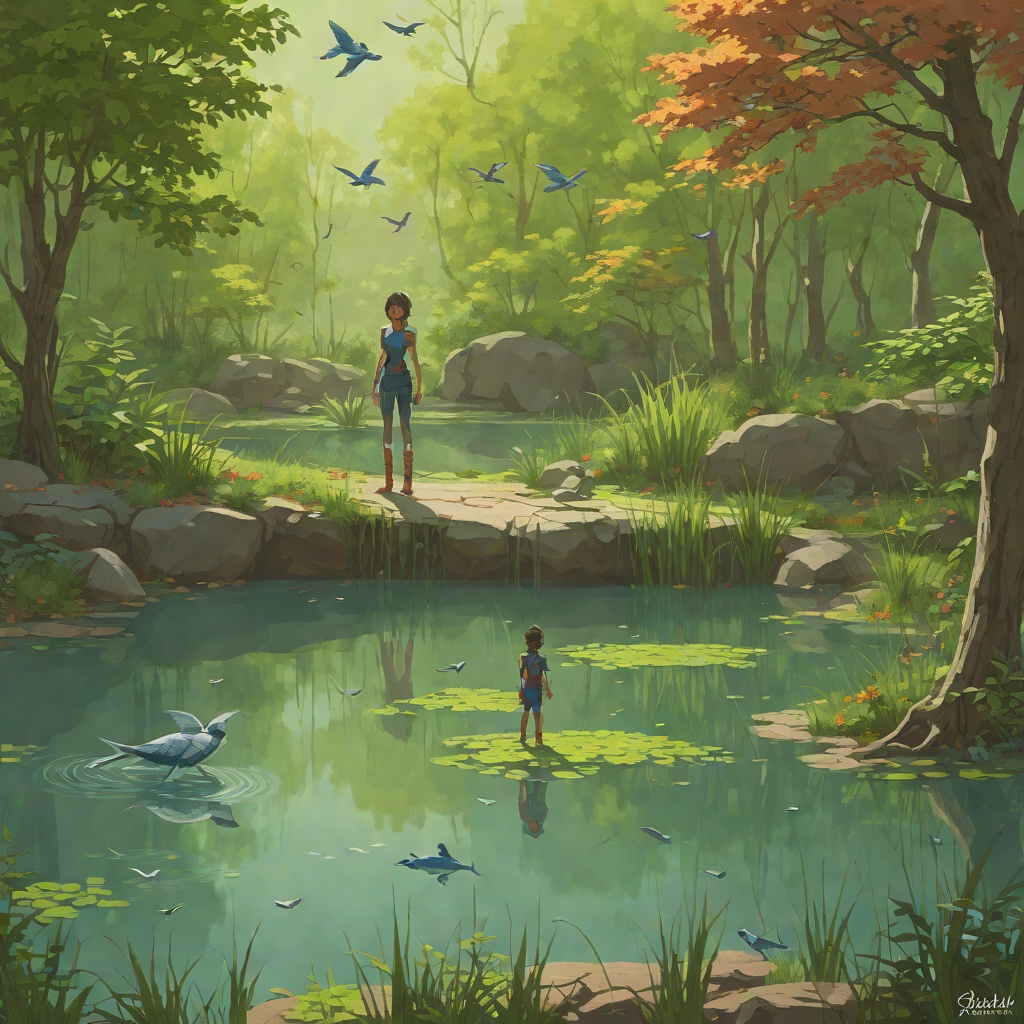
The most significant action of Brightbill's life is his departure with the migrating flock and his triumphant return. The story of how Roz helped Rockmouth spread across the river and across the island, followed by other stories of Roz growing gardens in dry, barren places, healing sick animals, and creating ropes, wheels, and tools to help her friends, but most of the new stories concerned the robot's wildness. Roz had noticed that the more wildly she acted, the more the animals loved her, so she barked with the foxes, sang with the birds, and hissed with the snakes, and this spring was a very crazy time for the robot. When the geese return, the flock is unlike most goose flocks, which move lazily through the sky and drift away in crooked lines; this flock was fast, flew in perfect V formation, and was led by a small, graceful goose. The flock flew once around the pond before gliding and wading gently into the water, gathering in a tight group in the middle of the pond, floating there for a moment, honking softly. Then the leader separated from the others, swam straight toward the Nest, waddled into the garden, and fluttered up to his mother's shoulder. "Welcome home, my son," said Roz, and Brightbill replied, "It's good to be back, Mom." This return marks Brightbill's transformation from a runt into a leader, and it confirms that Roz's unconventional motherhood has succeeded beyond all expectations.
Change and Ending
The emotional climax of Brightbill's story is the farewell scene, which reveals the depth of the bond between mother and son. When Roz declares, "You are my son and this is my home. I will do everything in my power to come back," Brightbill presses his face against his mother's worn face and says, "I love you, Mom." Roz replies, "I love you, son," and then the goose returns to his flock. This exchange, simple and direct, is the culmination of Brightbill's entire arc: the runt that Loudwing predicted would not last long has grown into a leader capable of leading a flock in perfect formation, and the robot that was once a strange, unnatural presence in the forest has become a mother worthy of love. The scene also establishes the central tension of the story's second half, as Roz's promise to return sets up her journey and the challenges she will face. Brightbill's role as the leader of the returning flock, flying in perfect V formation, is a direct contrast to the crooked, lazy lines of other flocks, and it signals that he has not only survived but thrived, carrying the lessons of his unusual upbringing into the wider world.
Narrative Role and Significance
Brightbill functions as the proof of Roz's humanity and the catalyst for her integration into the island's ecosystem. Without him, Roz would remain a mechanical outsider; with him, she becomes a mother, a builder, and a friend to the animals. His naming scene establishes the stakes of her motherhood, his growth shows her success as a caregiver, and his return validates her entire project of becoming wild. The story of Brightbill also exemplifies the book's broader themes of adoption, family, and the blurring of boundaries between the natural and the artificial. His bright beak, the source of his name, is a mark of his uniqueness, and his journey from a small, vulnerable hatchling to a graceful leader mirrors the arc of Roz herself, who begins as a lost, damaged machine and becomes an integral part of the island's life. The love between Brightbill and Roz, expressed in their simple exchange of "I love you," is the emotional heart of the book, and it demonstrates that family is not defined by biology but by care, devotion, and the willingness to do everything in one's power to return to those one loves.